
Picks: material, thickness and what each one does

Picks: material, thickness and what each one does
Picks are the cheapest variable in the whole signal chain and the one that changes attack most directly. They are also intensely personal, which is why a variety pack is a better first purchase than a hundred of one type.
Thickness
The number in millimetres on the pick is the specification that matters most.
Thin, under about 0.6mm
Flexes noticeably. Produces a bright, clicky attack and a softer note, which suits strumming chords on acoustic. Less controlled for single notes because the flex introduces delay between hand and string.
Medium, around 0.6 to 0.9mm
The general-purpose range. Enough stiffness for single-note work, enough give for strumming. Where most players end up if they are doing a bit of everything.
Heavy, above about 1mm
Barely flexes. All the energy goes into the string, giving a fuller, louder note with a defined attack. Preferred for lead playing, for bass, and by anyone who wants precision.
Heavier picks also produce less pick noise, because the pick is not slapping across the string.
Material
Celluloid is the traditional material: warm, with a distinct click, and it wears relatively quickly. It has a smooth feel that many players prefer, and it comes in the widest range of patterns.
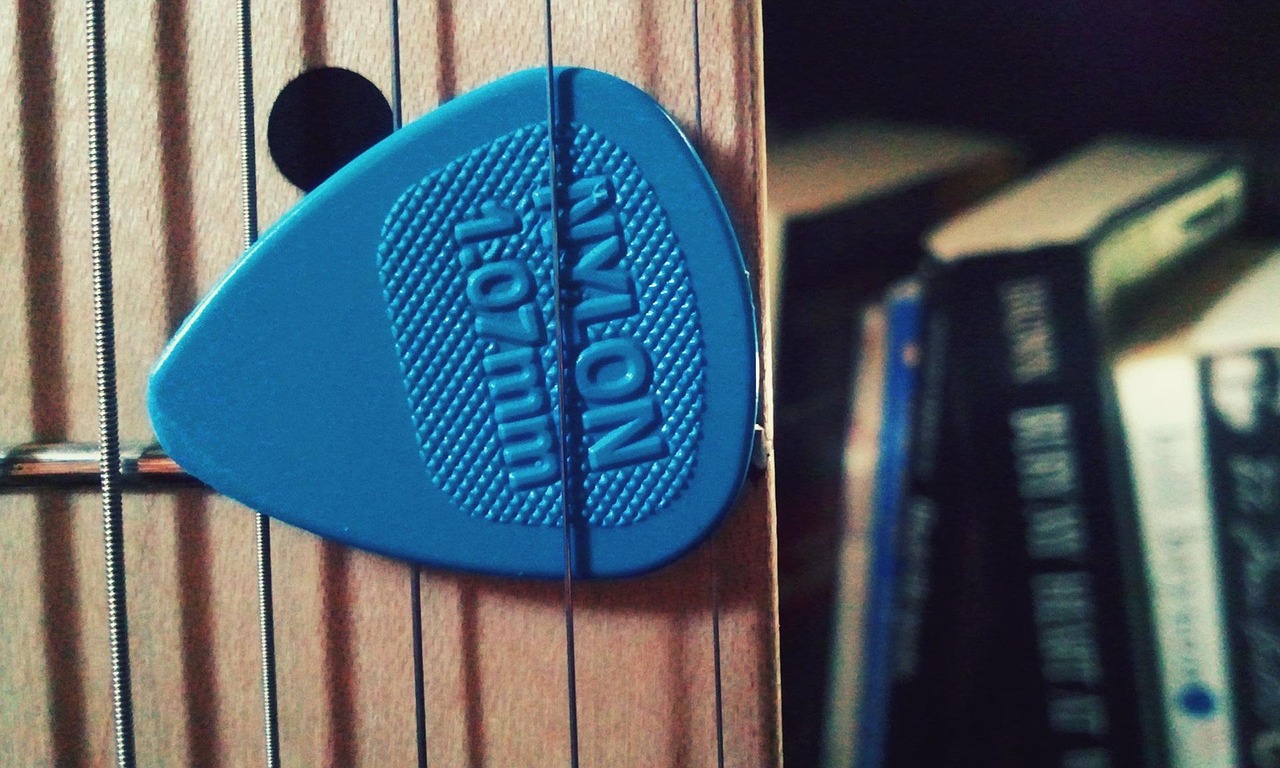
Nylon is grippier and more flexible at a given thickness. Delrin and similar plastics are harder, brighter and hold an edge longer.
Material differences are real but smaller than thickness differences. Someone convinced they need a particular material usually needs a particular thickness.
Shape and tip
Standard shape suits almost everything. Small teardrop shapes give more control for fast single-note work and are harder to hold for strumming. Large triangle shapes are easier to grip and popular with bass players.
Tip sharpness changes attack: a pointed tip is more articulate, a rounded tip is smoother and quieter.
Grip
Picks are dropped because hands sweat. Textured surfaces, raised grips and holes all address this. A cheap alternative is to keep a slightly worn pick — the roughened surface grips better than a new glossy one.
Using picks on bass
Bass strings are thicker and under more tension, so a thin pick flexes uselessly against them. Heavier picks — usually above 1mm — are the norm, and many bass players go considerably heavier again.
How many to buy
Picks are lost constantly. Buying a large multipack is not extravagance; it is the only way to have one when you need one. Keeping a few in the case, a few by the stand and a few in a coat pocket is the practical arrangement.
Practical checks before ordering
- Buy a variety of thicknesses before settling on one.
- Prioritise thickness over material.
- Go heavier for bass and for lead work.
- Consider grip texture if you drop picks.
- Buy more than you think you need — they disappear.
Where this sits in the shop
Everything discussed above comes back to one part of the shop: Straps and Picks, which currently holds 2 listings between $8.99 and $21.59. The whole of it is picked and packed at Yung Chin, 1776 Broadway, New York, NY, during Tue–Fri 7:30am–3pm, closed Sat–Mon — so anything written here can be checked by phoning the counter on ((212) 582-3626.
From our shelves
- YIKOKO Guitar Strap 2.5", Simply Soft Suede Leather Guitar Straps, Anti-Slip, Classic — $21.59
- 120 Pcs Celluloid Guitar Picks for Acoustic Electric Bass Guitars- 3 Sizes — $8.99
What we get asked about this
Is my card safe?
The card form belongs to our PCI DSS compliant payment provider. This website never sees a full card number.
How do I reach a human?
Email [email protected] and you will get a reply within 1 business day, or call (212) 582-3626 during shop hours (Tuesday–Friday 07:30–15:00 · Closed Saturday–Monday).
Read next
- Guitar stands and racks: how many instruments, and where
- Wall mounts: what the neck actually rests on
- Bass strings: gauge, winding and what each change does
Ordering from Yung Chin
Orders of $49.00 or more ship free anywhere in the United States, and a flat $5.99 covers everything below that. Handling takes 1–2 business days and carrier transit is normally 3–7 business days. Unused items can go back within 30 days, and if the mistake was ours we pay the return postage.
Questions about anything above go to [email protected], answered within 1 business day, or call (212) 582-3626. Full detail is on the Shipping Policy and Refund and Returns pages.